
The Most Comfortable Carriers for Small Dogs
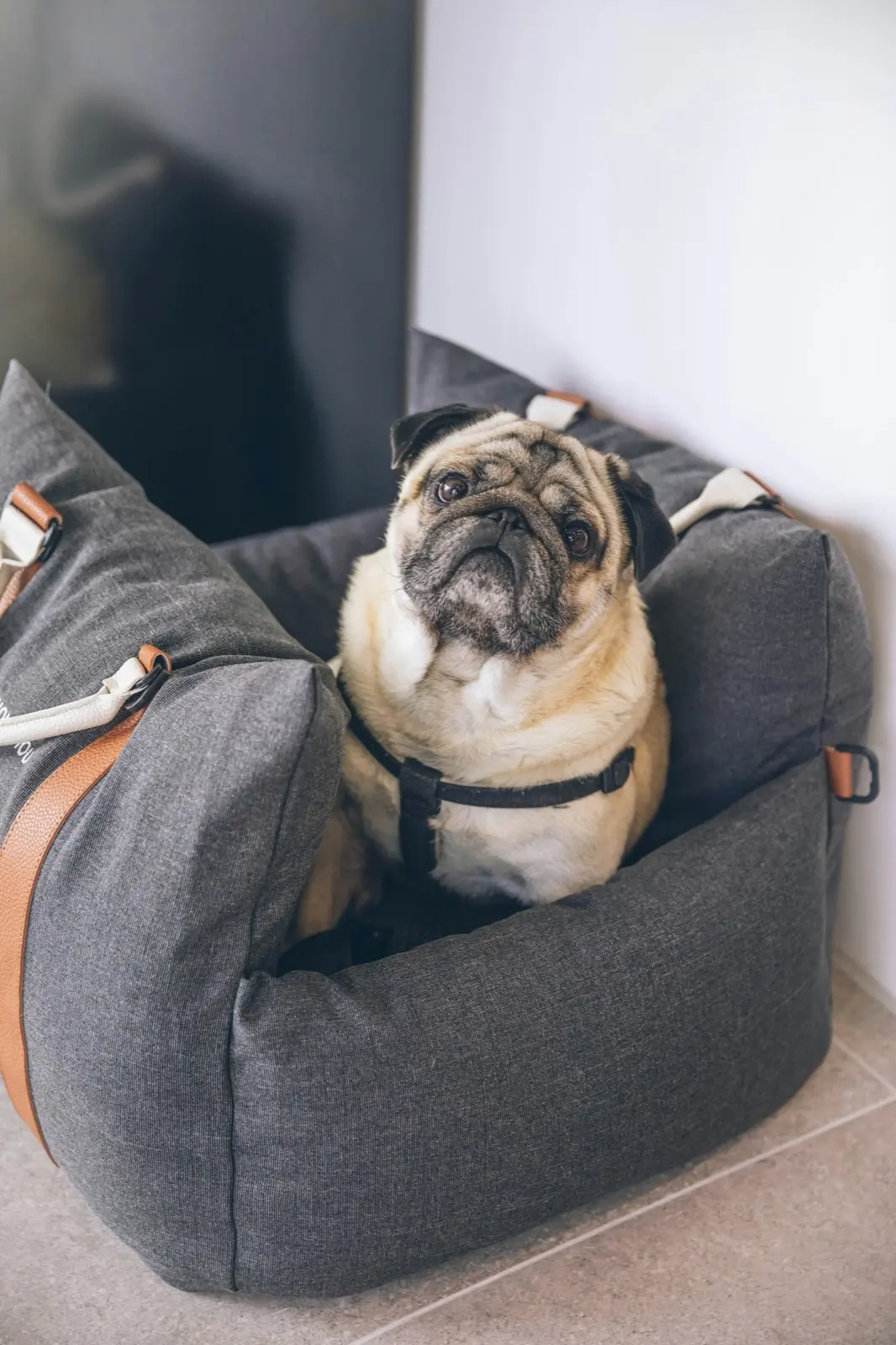
For a small dog, the carrier is the accessory that changes everything: it opens up public transit, cabin travel on a plane, a less stressful vet visit, or simply getting around the city without carrying your companion in your arms. But between “trendy” models with poor airflow and true carriers designed for animal comfort, the gap is wide. This guide reviews the criteria that really matter — ventilation, comfort, safety, cabin standards — so you can choose a carrier suited to your dog and your use, without being seduced by looks alone.
What size carrier should you choose for your dog?
This is the first criterion, and by far the most important. The reference rule is simple: your dog must be able to stand without their head touching the ceiling, turn around, and lie down comfortably inside. A carrier that’s too small is uncomfortable, even dangerous; one that’s too big lets the dog get tossed around and makes carrying harder.
To get the sizing right:
- Measure your dog’s length, from the tip of the nose (or base of the neck) to the base of the tail.
- Measure the height at the withers, dog standing, and add a few centimeters (about an inch) of margin.
- Weigh your dog and compare against the maximum weight stated by the manufacturer.
- Choose a size that leaves a little room to spare, without excess.
Careful: a puppy grows. If you buy early, anticipate their adult size or plan to replace the carrier. And keep in mind that soft carriers suit small dogs; beyond a certain weight, you move to a hard crate. To decide between formats, our comparison of dog carriers and crates details the uses of each.
Why is ventilation so important?
A carrier is an enclosed space where a stressed dog can quickly overheat. Insufficient airflow increases the risk of discomfort, excessive panting and, in extreme cases, heatstroke. It’s a safety point, not an aesthetic detail.
What to look for:
- mesh panels on at least two or three sides, not a single small window;
- mesh that’s fine but breathable, letting air and sight through without letting the dog push their head out;
- openings that don’t all end up pressed against your body when you carry the bag;
- airflow maintained even when the carrier is closed and set down.
When traveling, always add the right habits: avoid the hottest hours, never leave the carrier closed in direct sun or in a parked car, and offer water at stops. The carrier’s ventilation doesn’t replace the owner’s vigilance.
What makes a carrier genuinely comfortable?
Comfort comes from the padding, the stability, and the absence of anything bothering the dog. A soft, unstable base tires a dog who constantly has to rebalance; a flat, padded base gives them a reassuring place to settle.
The comfort features to prioritize:
- a padded rigid or semi-rigid base that doesn’t sag;
- a removable, washable cushion, more hygienic after an accident;
- walls that hold their shape and don’t collapse onto the dog;
- seams and zippers with no hard edges on the inside;
- for open carriers (sling-style), enough support for the body.
| Criterion | Why it matters | What to check |
|---|---|---|
| Ventilation | Heat comfort, safety | Mesh on several sides |
| Padded, stable base | Support, less fatigue | Rigid base + washable cushion |
| Cabin dimensions | Acceptance on the plane | Compare against airline limits |
| Sturdiness | Durability, safety | Seams, zippers, fabric |
| Internal tether | Prevents escape on opening | Built-in clip or strap |
| Carrying comfort | Owner comfort over time | Padded shoulder strap, back panel |
A dog at ease in their carrier is a dog who travels better. The reverse is also true: an uncomfortable carrier feeds stress, which in turn feeds discomfort. If your dog dreads transport, our advice on dog travel anxiety is a useful complement to choosing the gear.
How do you know the carrier is cabin-compliant for a flight?
To travel in the cabin, the carrier must slide under the seat in front of you and meet the dimensions and weight (dog + carrier) set by the airline. The essential point to understand: there is no single standard. Each airline has its own limits, sometimes varying by aircraft or class.
Before booking and before buying:
- Check your airline’s pet page for the maximum carrier dimensions.
- Verify the allowed total weight (dog + container), often just a few kilos (pounds).
- Confirm that soft carriers are accepted (most airlines prefer them in the cabin, since they compress under the seat).
- Reserve your dog’s spot in advance: the number of pets in the cabin is limited per flight.
- Keep the required health documents within reach.
A carrier sold as “cabin-approved” is approved for certain airlines — not necessarily yours. The golden rule: verify case by case. To prepare the whole air journey, from booking to paperwork, see our guide to flying with a dog.
Sturdiness and safety: what should you watch for?
A carrier protects your dog and prevents escapes: its sturdiness and safety features are therefore non-negotiable. A zipper that gives way or a seam that tears can turn a trip into a dangerous situation, especially in a crowded place or near traffic.
The safety points to check:
- an internal tether (strap or clip) to attach to the harness, so the dog doesn’t jump out when you open the carrier;
- robust zippers, ideally lockable or doubled;
- tough fabric and solid seams that support the dog’s weight and movements;
- a structure that doesn’t crush if something is set on it or if the carrier tips over.
Always tether to the harness rather than the collar: in a sudden movement, force on the neck is dangerous. On the model side, some references are known for their safety-first design — that’s the pitch of the Sleepypod line, for example, built around stability and the internal tether; as always, verify the official specifications and compatibility yourself before buying, rather than relying on reputation alone.
How do you carry the bag comfortably (for you and the dog)?
Carrying is often underestimated, yet it determines comfort over time. A badly carried bag tires the owner, who jostles it or sets it down poorly, which stresses the dog. Several formats exist depending on the use.
- Shoulder bag: practical in the city and for short trips; choose one with a padded, adjustable strap.
- Backpack: spreads the weight across both shoulders, ideal for walks and longer journeys.
- Wheeled / trolley carrier: spares your back at the airport or train station, but rolls poorly on uneven ground.
- Shoulder sling: very light for the tiniest dogs over short distances.
The right choice depends on your dominant use. For versatile city + travel use, many owners like a soft, well-ventilated carrier available in several sizes, like the popular Trixie Madison; here again, measure your dog and compare the dimensions against the official size guide and your airline’s requirements rather than trusting the product name alone.
Finally, whatever the carrier, habituation makes the difference: leave it open at home, slip in a blanket that smells like home, reward spontaneous entries, then gradually extend the closed and carried time before the real departure.
Sources
Frequently asked questions
What's the maximum weight for a dog in a cabin carrier?
It depends entirely on the airline. Many limit the total weight (dog + carrier) to just a few kilos, often around 8 kg (18 lb), but this figure varies. Always check your airline's official page before buying a carrier or booking, because above the limit the dog travels in the hold or not at all.
Soft carrier or hard crate for travel?
For the airplane cabin, soft carriers are generally preferred because they compress under the seat. For the hold, the car, or large dogs, an approved hard crate is safer. The choice depends on your dog's size, the mode of transport, and the length of the trip.
How do I get my dog used to their carrier?
Leave the carrier open and accessible at home for several days, with a familiar blanket inside. Reward each voluntary entry, then close it for a few seconds, carry it over short distances, and extend gradually. The goal is for the carrier to become a refuge associated with positive things before the first real trip.
My carrier is sold as \"cabin-approved\" — is that enough?
Not necessarily. The \"cabin-approved\" label matches the dimensions of certain airlines, not necessarily yours. Always compare the carrier's dimensions against the official limits of the airline you're flying, and confirm that soft carriers are accepted and that pet spots are still available on the flight.
Should I tether my dog inside the carrier?
Yes. When the carrier has an internal tether (strap or clip), it's recommended to clip it to the dog's harness — never the collar. This prevents them from suddenly jumping out when you open it, in a busy place or near traffic, and makes handling safer.