
Which Harness Should You Choose for a Dog That Pulls?
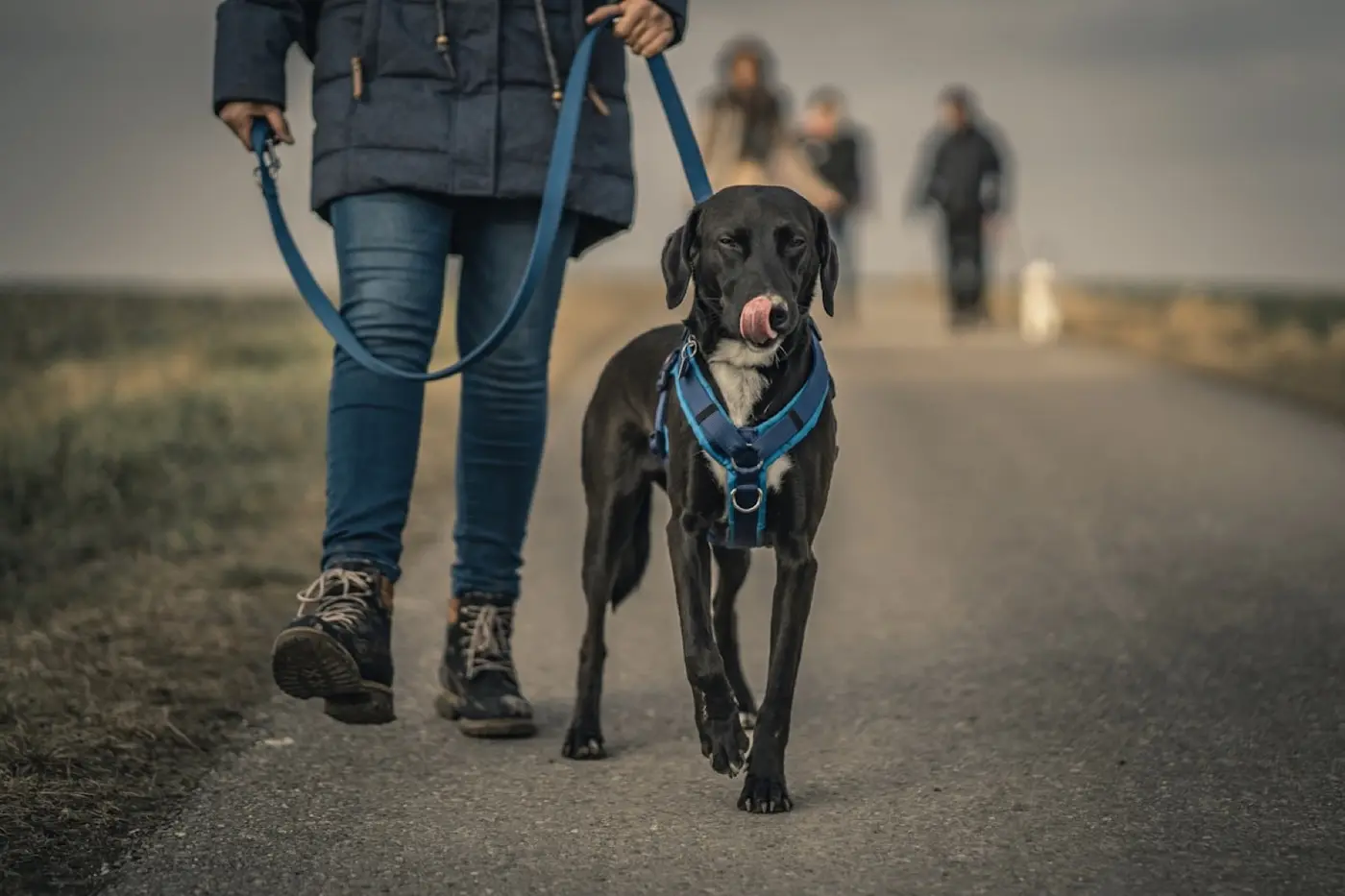
If your dog turns every walk into a sled-pulling session, you’re not alone. Leash pulling is one of the most common reasons owners call a dog trainer. Many hope an accessory will fix the problem in a single outing — and that’s where disappointment creeps in, or worse, ill-suited purchases that hurt the dog.
Let’s be honest up front: no harness teaches a dog not to pull. What a good harness does do is make pulling less effective for the dog, more bearable for your shoulder, and above all safe for their neck and airway — unlike a collar, which concentrates all the force on the trachea. It’s a transition tool while you work on leash manners, not a magic fix. This guide helps you choose the right type, understand the criteria that really matter, and measure correctly before buying.
Why a harness rather than a collar for a dog that pulls?
When a dog pulls against a collar, all the force is concentrated on a narrow band of the neck: trachea, larynx, cervical vertebrae and thyroid gland. For a dog that pulls hard and often, that repeated pressure is no small thing — it’s especially risky for small breeds, brachycephalic (short-muzzled) dogs and dogs prone to respiratory issues.
A harness spreads the force across the chest and torso — muscular zones far better equipped to absorb it. It’s a safety issue first, a comfort issue second.
Beware of one stubborn myth, though: a classic back-clip harness does not stop pulling. On the contrary, it can trigger the “opposition reflex” — the more you pull the dog back, the harder they push forward, exactly like a sled dog in a harness designed for that job. That’s why the clip position becomes the central criterion.
What are the different types of no-pull harness?
There are three main families, based on where the leash attachment point(s) sit:
- Back-clip harness: the most common and the most comfortable for everyday wear. Ideal for a dog that pulls little or not at all, or for sporty outings. On its own, it does nothing to reduce pulling.
- Front-clip harness: the ring sits in front, at the sternum. When the dog pulls, the tension pivots them sideways toward you, breaking their forward momentum. It’s the classic no-pull design.
- Dual-clip harness (front + back): the most versatile. Clip in front during the training phase, in back once leash manners are solid or for sports. A double-ended leash even lets you use both at once for better control.
| Harness type | Effect on pulling | Everyday comfort | Best for |
|---|---|---|---|
| Back clip only | Weak (can make it worse) | Excellent | Calm dogs, sports, canicross |
| Front clip | Good (sideways redirection) | Good | Training, dogs that pull |
| Dual clip | Very good (adaptable) | Good | Versatile, training transition |
Avoid: “no-pull” harnesses that tighten or pinch under the armpits when the dog pulls. They may work through discomfort, but the risk of injury and of a negative association with walks generally isn’t worth the result.
What criteria should you check before buying?
Beyond the clip position, several details separate a good harness from an accessory that chafes or injures.
- The clip position: for a dog that pulls, go for a front clip or, better, a dual clip. This is criterion number one.
- Adjustability: look for at least 4 adjustment points (two at the neck, two at the chest/belly). The more adjustable straps, the better the harness hugs your dog’s build, especially if they have an unusual shape.
- Padding: padding at the contact points (chest, under the belly) spreads pressure and prevents hard spots. Essential for a puller, because that’s exactly where the force lands.
- Anti-chafing: check that no strap runs directly through the armpit hollow, a fragile zone where irritation appears fast. Edges should be smooth, ideally lined.
- Breathability: for long walks or hot weather, an airy mesh back prevents overheating. A harness that covers a lot of surface runs warmer.
- Stitching and buckle strength: for a powerful dog, metal or reinforced-plastic buckles and triple-stitched seams beat lightweight clips.
- Ease of putting on: over-the-head (Norwegian or H-style) versus step-in/clip-around — depending on whether your dog tolerates something passing over their head.
How do you measure your dog properly?
This is the step everyone rushes, and the number-one cause of a harness that chafes or slips. Too big, and the dog can back out of it; too small, and it rubs and injures.
Grab a soft tape measure and note two key measurements:
- Chest girth: the crucial one. Measure the circumference of the torso at its widest point, just behind the front legs.
- Neck girth: at the base of the neck, where a collar would sit.
Weigh your dog too: many size charts combine weight and chest girth. If you land between two sizes, trust the chest girth over the weight, and check that the chosen size covers your measurement within its adjustment range. The final-fit rule: you should be able to slide two flat fingers between the strap and your dog’s body — no more, no less.
Which model for which dog?
Here are two widely cited references — treat them as examples of their categories rather than universal recommendations. Measure your dog and check the official size charts before any purchase.
- Julius-K9 IDC Powerharness: an over-the-head, back-clip harness with a reputation for toughness, popular for powerful dogs and controlled pulling sports. Note: it’s a back-clip model, so it’s geared toward control and durability rather than front-clip no-pull redirection. It suits medium to large dogs whose outings you want to manage firmly without necessarily working on redirection.
- Ruffwear Front Range: a versatile dual-clip harness (front and back), well padded, often recommended for daily walks and leash training. The front ring makes it a good candidate for a dog that pulls and is being retrained toward a loose leash.
In short: for a dog still learning leash manners, a front-clip or dual-clip model makes more sense. For a big, sturdy dog where you mostly want solid, comfortable control, a well-built back-clip model can be enough. And if you’re planning hikes, think about the use case: see our guide to mountain trips with your dog for harnesses suited to terrain and long distances.
Is the harness enough, or do you also need to retrain?
The harness is a tool, not a method. For a dog to stop pulling for good, they need to learn that pulling gets them nowhere — and that walking near you does. A few simple principles:
- Stop when they pull, move again when the leash goes slack. The dog learns that tension leads nowhere.
- Reward walking at your side with treats or your voice, especially early on.
- Skip the retractable leash during training: it keeps constant tension and muddies the message.
- Be consistent: everyone in the household must apply the same rule.
A front-clip harness makes this work easier by making pulling less rewarding, but it’s your consistency that pays off over time. And remember that car safety is a separate piece of gear: see our guide to dog car harnesses — a walking harness is not designed for vehicle travel.
Sources
Frequently asked questions
Does a harness actually stop a dog from pulling?
No, not on its own. A front-clip harness makes pulling less effective by redirecting the dog toward you, which helps during training. But it's loose-leash training that stops pulling for good. The harness is a transition tool, not an automatic fix.
Front clip or back clip for a dog that pulls?
For a dog that pulls, the front clip (on the chest) is clearly more effective: when the dog pulls, it pivots them sideways and breaks their momentum. A back clip alone can actually increase pulling through the opposition reflex. A dual-clip harness offers the best compromise, adaptable to the moment.
How do I know the harness is the right size?
Measure the chest girth (just behind the front legs, at the widest point) and the neck girth with a soft tape measure, then compare against the manufacturer's size chart. Once on, you should be able to slide two flat fingers between the strap and your dog's body. If it slips or rubs at the armpits, the size or the fit is wrong.
Are harnesses that tighten when the dog pulls recommended?
They work through discomfort — even pinching under the armpits — and carry a risk of injury and of your dog forming a negative association with walks. Most positive-reinforcement trainers prefer a front-clip harness, which redirects without punishing. Avoid them for daily use.
Can I use the same harness in the car?
No. A walking harness isn't designed or crash-tested to withstand an impact in a car. For car travel you need a dedicated safety harness attached to the seat belt, or an approved travel crate. They are two distinct pieces of gear with different jobs.