
Flying with a Dog: Cabin, Hold, Cargo and Other Options
Flying with a dog is not a one-answer question. Depending on the animal’s size, the airline, the destination and your situation, several solutions exist — and they don’t come with the same price, the same comfort level or the same constraints. Here is the complete panorama of ways to take a dog into the air, from the most common to the most exotic. To find the right airline for your route, keep our “can my dog fly?” checker and the comparison of all 62 airlines close at hand.
1. In the cabin: the most reassuring option
The cabin is reserved for small dogs. The near-universal rule: the dog and its travel carrier must not exceed a maximum weight, most often 8 kg (18 lb) (sometimes 6 kg / 13 lb, up to 10 kg / 22 lb at a few low-cost carriers such as Vueling or Volotea). The carrier must be soft-sided, within the airline’s required dimensions, and fit under the seat in front of you. The animal must stay inside for the entire flight.
It’s the most reassuring formula: your dog stays with you, at normal temperature, far from the stress of the hold. The fee generally ranges from €30 to €250 (~$35–290) depending on distance. Since the number of pet spots in the cabin is limited (often 1 to 6 per aircraft), book early and by phone. To prepare your companion for the flight, see our advice on dog travel anxiety.
2. In the hold: for bigger dogs
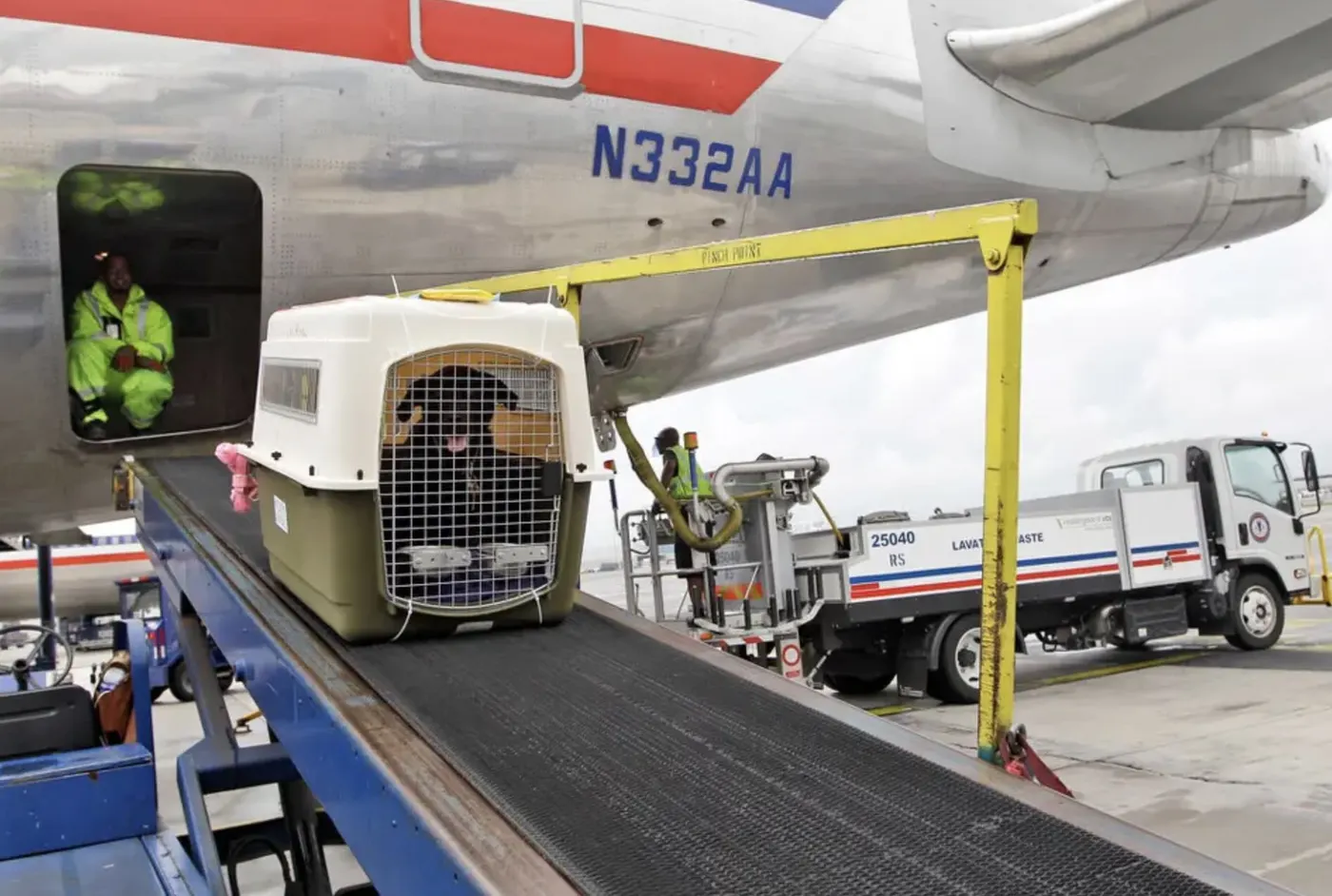
Above the cabin weight limit, the dog travels in the hold, in a pressurized, heated compartment designed for live animals (code AVIH in airline jargon: Animal in Hold). This is always accompanied baggage: your dog travels on the same flight as you, under your ticket.
The conditions: a rigid IATA-approved crate (sturdy, ventilated on several sides, with a leak-proof floor and metal hardware), a maximum combined weight for dog + crate (often up to 45 or 75 kg / 99 or 165 lb depending on the airline), and an advance reservation. Crucial point: most airlines ban brachycephalic breeds from the hold (bulldogs, pugs, boxers…) for respiratory health reasons. Size the crate with our IATA crate calculator and read our guide to choosing an airline-approved crate.
3. As cargo: not to be confused with the hold
This is the distinction many people miss. Cargo (freight) is not the same thing as the hold as accompanied baggage. As cargo, the dog travels as merchandise shipped by the airline’s cargo division, possibly on a different flight from yours, with its own logistics.
It’s used in several cases: a dog too heavy for the passenger hold (beyond ~45–75 kg / 99–165 lb with the crate), an airline that has dropped hold transport for passengers (the case of Delta, United and American Airlines in the US, which now only offer cargo), or destinations that only accept animals via freight (the UK, or the UAE for Dubai…). Cargo transport is priced by quote, often through a specialized agent (a “pet shipper”), with heavier customs paperwork. It’s the most expensive and most bureaucratic option, but sometimes the only one possible for a large dog on a long-haul flight.
4. The service dog: the cabin, for free
Properly trained service dogs — first and foremost guide dogs for blind or visually impaired people, but also assistance dogs for mobility impairments, epilepsy, diabetes, and so on — enjoy a status of their own. They are admitted into the cabin, free of charge, without a crate, lying at their handler’s feet, whatever their size.
The conditions concern proof of status: the animal must be a certified service dog (in the United States, the airline requires the official DOT form attesting to training and behavior; in Europe, proof of assistance-dog status is requested). The dog must be house-trained, calm and under control. This framework is protected by accessibility regulations: an airline cannot refuse a genuine guide dog.
5. The emotional support dog: a case that has become rare
Don’t confuse a service dog with an emotional support animal (ESA). The latter is not trained for specific tasks; it soothes by its presence alone. Since a reform by the US Department of Transportation (DOT) that took effect in early 2021, airlines are no longer required to treat emotional support animals as service dogs. As a result, nearly all major US carriers have stopped accepting them free in the cabin; the animal then travels as an ordinary pet (in a carrier under the seat, for a fee, and only if it’s small enough).
A few carriers in the Americas still recognize ESA status (examples often cited include LATAM, Volaris and WestJet), but always under conditions. In Europe, emotional support is not a category recognized by aviation regulations: the dog is treated as a regular pet. In short: don’t count on this status to fly a large dog in the cabin for free — always check the airline’s exact policy.
6. Dog-only airlines: traveling side by side
This is the newest and most spectacular solution. Airlines entirely dedicated to dogs have appeared: the dog travels neither in the hold nor in a crate, but in the cabin, uncrated, next to its human, aboard shared private jets or aircraft fitted out in a premium configuration.
The most publicized is Bark Air, launched in May 2024: a charter operator, it flies jets (Gulfstream) and larger aircraft (CRJ-200s that can carry about twenty dogs and their owners), with treat stations, calming pheromones, bone broth as a beverage and paw-pad balms. Fares match the concept: on the order of $6,000 for New York–Los Angeles and $8,000 for New York–London, with routes to Paris, Lisbon, Madrid, Berlin and Milan. Another player, K9 Jets, based in the UK, offers private flights (for example New York–Paris or Lisbon–London) where the animal travels in the cabin at your side. These options remain a luxury, but they answer a real demand: traveling with a large dog without ever putting it in the hold.
Which option should you choose?
For the vast majority of travelers, the choice comes down to cabin (small dog) or hold (medium to large dog) on a regular airline — cargo being reserved for special cases, and dog-only airlines for exceptional budgets. Before booking, always check the destination country’s entry requirements (see our dog travel requirements by country) and compare conditions with the airline pet policy comparison. For the practical details of a standard flight, our guide to flying with a dog walks through every step.
- Check the health requirements
- Choose an IATA-approved travel crate
- Prepare your dog for the stress of the flight
- Compare all 62 airlines
Sources
US DOT — Service Animals · BARK Air · K9 Jets. Airline policies reviewed in June 2026; conditions change, verify before booking.
Frequently asked questions
What is the difference between the hold and cargo?
In the **hold** (accompanied baggage, AVIH), the dog travels on your flight, under your ticket, in an IATA crate. As **cargo**, it is shipped as freight, sometimes on a different flight, priced by quote and with heavier paperwork.
Does an emotional support dog fly free in the cabin?
No, not anymore in most cases. Since 2021, US airlines are no longer required to accept them as service dogs; they travel as pets (paid, in a carrier). In Europe, this status is not recognized.
Does a guide dog pay for its ticket?
No. Certified service dogs travel free in the cabin, without a crate, whatever their size, subject to documentation.
Are there airlines just for dogs?
Yes: Bark Air (since 2024) and K9 Jets offer flights where the dog travels in the cabin at your side, on jets or premium-configured aircraft. Fares are high (several thousand dollars).